Battery passport
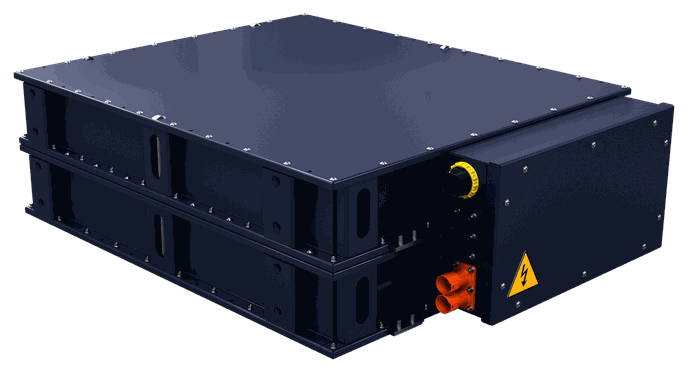
LFP-Modularcontainer 358 V 37 kWh · individual battery 2026-02-00037-0274
Industrial battery · LFP · 36.56 kWh · CE · Regulation (EU) 2023/1542
This page is the digital record of one individual battery pursuant to Art. 77 and Annex XIII of Regulation (EU) 2023/1542. It is reached through the QR code on the battery housing or directly at https://id.batteries.eu/2026-02-00037-0274/. The underlying field list is documented in the battery passport requirements.
Applicability: under Art. 77(1) the battery passport is required for batteries placed on the market or put into service from 18 February 2027. The example battery shown here was placed on the market in 2026 and would not yet be covered; the carbon footprint performance class (from 18 August 2027 at the earliest — Art. 7(2) third subparagraph — or 18 months after the entry into force of the delegated act and the implementing act under the fourth subparagraph, whichever is later), the minimum recycled shares (from 18 August 2031) and the QR code (from 18 February 2027) likewise did not yet apply to it when it was placed on the market. This version illustrates the structure of a passport under the law as it will apply from 2027.
🔒 Sign in for extended access · ⤓ JSON export · Structure of the identifier
At a glance
| Serial number | 2026-02-00037-0274 |
|---|---|
| Manufacturer | Sunlight Group Energy Storage Systems, Xanthi (GR) |
| Model | LFP-358V-37kWh |
| Category | Industrial battery |
| Manufactured on | 12 January 2026 at the Neo Olvio plant |
| Capacity | 36.56 kWh / 102 Ah |
| Chemistry | LFP |
| Weight | 330 kg |
| Carbon footprint | 64.2 kg CO₂eq/kWh — performance class B |
| Renewable content | 0 % |
| Recycled content | 7 % Li |
| Expected lifetime | 4 000 cycles, 8-year warranty |
Data on the current use of this individual battery (status, state of health, charge/discharge cycles and more) is visible in level 4, after signing in with a grant on this battery.
Contents
-
Model information — public
- a) General information
- b) Material composition
- c) Carbon footprint
- d) Responsible sourcing
- e) Recycled content
- f) Share from renewable sources
- g) Rated capacity
- h) Voltage
- i) Original power capability
- j) Expected lifetime in cycles
- k) Capacity threshold for exhaustion
- l) Temperature range in idle state
- m) Commercial warranty for the calendar life
- n) Round trip energy efficiency
- o) Internal resistance
- p) C-rate of the cycle-life test
- q) Labelling
- r) EU declaration of conformity
- s) Waste prevention and waste battery management
- 🔒 Model information — restricted access (level 2)
- 🔒 Model information — authority access (level 3)
- 🔒 Data on this individual battery (level 4)
- Access levels and sign-in
Level 1 — model information (public)
a) General information
Annex VI Part A of the Regulation. This information also appears on the physical label on the battery.
| Manufacturer | Sunlight Group Energy Storage Systems · Topeiros, 672 00 Xanthi, GR · web address https://www.sunlight-group.com/ · contact point commercial-mobility@triathlon-batterien.de |
|---|---|
| Battery category | Industrial battery |
| Identification of the battery | Model LFP-358V-37kWh · product code P358-102-AFC-LFP-8S1P · serial number 2026-02-00037-0274 |
| Place of manufacture | Neo Olvio plant, GR (41.03° N, 24.80° E) |
| Date of manufacture | January 2026 |
| Weight | 330 kg |
| Capacity | 36.56 kWh / 102 Ah |
| Chemical composition | Cathode LFP · anode graphite · electrolyte LiPF₆ in EC/DMC/EMC |
| Hazardous substances other than Hg/Cd/Pb | LiPF₆, ethylene carbonate, dimethyl carbonate, ethyl methyl carbonate, vinylene carbonate — details in the safety data sheet |
| Extinguishing agent | Water spray in large quantities or special aerosol F-500 EA. Not suitable: CO₂, foam, ABC powder |
| Critical raw materials > 0.1 % m/m | see table below |
Critical raw materials as mass fractions of the whole battery:
| Raw material | Share |
|---|---|
| Nickel | 0 % |
| Aluminium | 9.8 % |
| Copper | 6.5 % |
| Natural graphite | 6.5 % |
| Lithium | 1.2 % |
| Cobalt | 0 % |
| Manganese | 0 % |
| Phosphorus | 6.1 % |
b) Material composition
- Cell chemistry: lithium-ion, LFP cathode LiFePO₄, graphite anode, organic carbonate electrolyte with LiPF₆ as conducting salt
- Further components: polyolefin separator, aluminium cathode collector, copper anode collector, aluminium module housing, steel housing
- Hazardous substances (other than Hg/Cd/Pb): LiPF₆, EC, DMC, EMC, VC
- Critical raw materials: see the table in a)
c) Carbon footprint
Calculated under Art. 7 and the methodology of the Commission delegated act pursuant to Art. 7(1) fourth subparagraph point (a).
| Manufacturer | Sunlight Group Energy Storage Systems |
|---|---|
| Model / manufacturing plant | LFP-358V-37kWh / Neo Olvio plant, GR (41.03° N, 24.80° E) |
| Carbon footprint | 64.2 kg CO₂eq per kWh of total energy over the service life |
| Performance class (Art. 7(2)) | B |
| EU declaration of conformity no. | DECL-LFP-358V-37kWh-001 |
| Accompanying study | Carbon footprint study LFP-358V-37kWh (PDF) |
Breakdown by life cycle stage (Annex II, point 4):
| Stage | kg CO₂eq / kWh |
|---|---|
| Raw material acquisition and pre-processing | 38.1 |
| Main product production | 18.9 |
| Distribution | 1.4 |
| End of life and recycling | 5.8 |
| Total | 64.2 |
d) Responsible sourcing
Annual due diligence report: Report for the 2018 financial year (PDF)
- Steps taken to fulfil due diligence obligations (Art. 49 and 50): risk assessment of the supply chains for cobalt, lithium, nickel and natural graphite; annual audit of all tier-1 suppliers; membership of the Responsible Minerals Initiative (joined 2016); due diligence obligations included in all supply contracts from 2017 onwards.
- Adverse impacts identified (Annex X, point 2): Evidence open — findings from the supply chain review have not been established yet.
- Independent verification under Art. 51 by TÜV Nord Cert GmbH, notified body 0123, report ID UV-2018-0418.
- Access to information, public participation in decision-making and access to justice in environmental matters: not relevant for the supply chains concerned here (no operations in conflict-affected or high-risk areas in the 2018 reporting year).
e) Recycled content
Evidence per model, year and manufacturing plant pursuant to Art. 8(1).
| Substance | Share recovered from waste |
|---|---|
| Cobalt in the active materials | not present |
| Lithium in the active materials | 7 % |
| Nickel in the active materials | not present |
| Lead in the battery | not present |
The value for lithium already meets the minimum share applicable from 18 August 2031 (Li 6 %; Art. 8(2)). The minimum shares for cobalt (16 %) and nickel (6 %) do not apply here, as the battery contains neither cobalt nor nickel. The minimum share for Pb (85 %) does not apply here, as the battery contains no lead.
f) Share from renewable sources
0 % of the mass of this battery consists of materials from renewable sources (bio-based materials such as lignin), taken as the mass of renewable material divided by the total mass of the battery.
g) Rated capacity
102 Ah
h) Voltage
| Characteristic | V |
|---|---|
| Minimum | 280 |
| Nominal | 358.4 |
| Maximum | 408.8 |
valid in the temperature range −20 °C to +60 °C
i) Original power capability
- Continuous power 36.6 kW
- Peak power 36.6 kW
- Power limits: full power from +10 °C to +50 °C, reduced outside that range
- Operating temperature range: −20 °C to +60 °C
- Ratio between nominal power and energy: 1.0 W/Wh
j) Expected lifetime in cycles
4 000 full cycles until the capacity threshold, measured under IEC 62620 (1 C / 1 C, +25 °C, DOD 80 %).
k) Capacity threshold for exhaustion
Not applicable — Annex XIII, point 1(k) applies to electric vehicle batteries only; no capacity threshold for exhaustion is to be given for this industrial battery.
l) Temperature range in idle state
−20 °C to +45 °C (storage, transport; tested under UN 38.3).
m) Commercial warranty for the calendar life
8 years from entry into service. Remaining capacity at the end of the warranty period at least 70 %.
n) Round trip energy efficiency
| At the beginning | 96 % |
|---|---|
| After 50 % of the cycle life | 91 % |
o) Internal resistance
| Battery cell | 0.8 mΩ |
|---|---|
| Battery pack | 125 mΩ |
p) C-rate of the cycle-life test
1 C / 1 C (charge / discharge)
q) Labelling
Annex XIII, point 1(q) refers to Art. 13(3) and (4):
- Art. 13(3) (labelling of non-rechargeable portable batteries) — not applicable to this rechargeable industrial battery.
- Art. 13(4) — the “separate collection” symbol under Annex VI Part B is applied to the battery. Size: 5.0 × 5.0 cm — the maximum permitted under Art. 13(4), as 3 % of this battery’s largest side face would exceed it.
Further physical markings on the housing (informative — other legal bases):
| Marking | Legal basis | Location | Size |
|---|---|---|---|
| “Separate collection” symbol (crossed-out wheeled bin, Annex VI Part B) | Art. 13(4) | Top of the housing | 5.0 × 5.0 cm |
| CE marking | Art. 19 and 20 | Top of the housing, next to the collection symbol | 1.0 × 0.7 cm |
| QR code pointing to this battery passport | Art. 13(6), Annex VI Part C | Top of the housing | 3.5 × 3.5 cm |
Art. 13(5) (chemical symbol Cd or Pb) does not apply: cadmium and lead are below the thresholds of 0.002 % and 0.004 % respectively.
r) EU declaration of conformity
DECL-LFP-358V-37kWh-001 following the model in Annex IX. It states that fulfilment of the requirements of Art. 6 to 10 and 12, 13 and 14 has been demonstrated.
s) Waste prevention and waste battery management
Mandatory information under Art. 74(1)(a)–(f):
- Role of end-users in waste prevention: charge between 20 % and 80 % SOC, avoid deep discharge and prolonged storage at extreme temperatures, keep the software up to date. In the event of a defect, have a diagnosis carried out before replacing the battery – remanufacturing is possible through the partner network. Possibilities of re-use, preparing for re-use, preparing for repurposing, repurposing and remanufacturing: remanufacturing.
- Role in separate collection (Art. 64): waste batteries of this category must not be put in household waste or other waste streams (Art. 64(1)); they must be handed in at a designated collection point (Art. 64(2)); if a waste battery is still built into the machine or installation, a specialist must remove it before hand-in.
- Available take-back, collection and treatment: only the manufacturer, Sunlight Group Energy Storage Systems, takes back waste batteries of this category, free of charge. Please arrange the return with the manufacturer (notes). Preparing for re-use and preparing for repurposing: open. Treatment is carried out by Beispielrecycling GmbH (permit DE-Recycling-2018-0042 issued by the competent authority).
- Safety instructions for handling: in case of visible damage, odour, smoke or heating, do not touch the battery, keep a safety distance of at least 5 m and call the fire brigade, stating “lithium-ion battery”. Store damaged batteries only in non-combustible containers in the open air. Lithium-ion batteries carry the risk of thermal runaway.
- Meaning of the symbols on the battery (Art. 13): crossed-out wheeled bin – separate collection required; CE – conformity with Union law; QR code – reference to the battery passport.
- Effects of the substances contained: on contact with moisture, LiPF₆ reacts to form hydrofluoric acid (HF), which harms the skin, eyes and respiratory tract. Improper disposal may lead to soil and water pollution. This battery does not contain mercury, cadmium or lead above the limit values.
Level 2 — model information with restricted access
🔒 Annex XIII, point 2 — visible to persons with a legitimate interest, notified bodies, market surveillance authorities and the Commission (Art. 77(2)(b) and (c))
Level 3 — model information with authority access
🔒 Annex XIII, point 3 — visible only to notified bodies, market surveillance authorities and the Commission (Art. 77(2)(b))
Level 4 — data on this individual battery
🔒 Annex XIII, point 4 — visible to persons with a legitimate interest (Art. 77(2) third subparagraph): repairers, remanufacturers, second-life battery users and recycling operators (point (a)), as well as purchasers of the battery and parties acting on their behalf — such as energy aggregators or energy market participants (point (b))
Access levels and sign-in
| Level | Annex XIII | Access | Sign-in |
|---|---|---|---|
| 1 | point 1 | anyone | not required |
| 2 | point 2 | legitimate interest + notified bodies + market surveillance + Commission | certified account |
| 3 | point 3 | notified bodies + market surveillance + Commission | authority account |
| 4 | point 4 | legitimate interest | certified account |
| 1–4 | points 1–4 | manufacturer (Sunlight) | Sunlight account |
The exact scope of data per role follows the Commission implementing act pursuant to Art. 77(9). The data is based on open standards and can be retrieved in an interoperable, machine-readable format through the Sunlight Batterien Passport API (Art. 77(5)).
Passport ID 2026-02-00037-0274 · identifier under the operator scheme id.batteries.eu/passport-id, not ISO/IEC 15459-registered · last updated 18 August 2026 · economic operator responsible: Triathlon Batterien GmbH (Art. 77(4)) · This record is deleted once the battery has been recycled (Art. 77(8)).